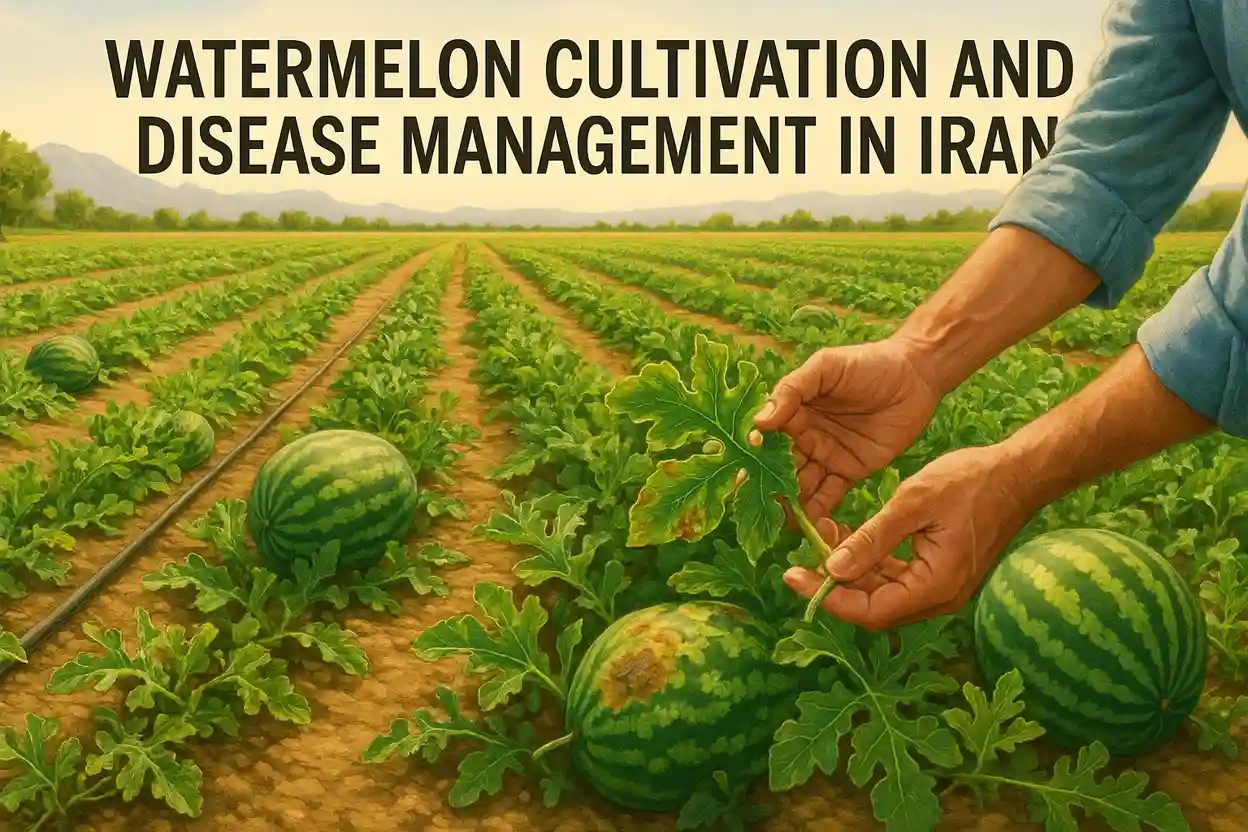
Watermelon Cultivation and Disease Management in Iran
Introduction
Watermelon (Citrullus lanatus) is one of the most important vegetable crops in the Cucurbitaceae family, cultivated both commercially and in home
gardens around the world — from Iran to the United States and East Asia.
Due to its long history of production in Iran, all standard and hybrid varieties can be successfully cultivated across the country. Watermelons generally show
excellent adaptation to local climates, and with proper irrigation, high-quality fruits can be produced during summer.
Correct identification and understanding of common watermelon diseases is therefore essential for every professional grower.
Planting Seasons in Iran
Early planting for Yalda Night market supply begins by transplanting seedlings on plastic mulch, mainly in the southern provinces such
as Kerman, Sistan‑Baluchestan, and Hormozgan.
Main and late sowing is typically performed directly by seeding during April and May, depending on soil temperature. Late‑season production can continue
until the first frost, provided plants remain healthy and active .
Each plant usually sets fruit in up to three flushes, and hybrid varieties such as B32 and Himalaya F1 produce uniform
fruit size from the first through third and fourth blossoms.
Watermelon Diseases
Diseases are widespread and can severely reduce fruit quality and yield. They may occur at any time during the crop cycle, affecting all tissues — from root to fruit.
Leaf diseases are particularly damaging as they cause premature defoliation, exposing fruits to sun‑scald and disturbing
sugar accumulation and fruit maturity.
When fruits themselves become infected, they lose market value and rapidly deteriorate during transport. Fortunately, with proper management,
most watermelon diseases can be controlled effectively and yield can remain stable.
Causal Agents
Diseases are caused by various pathogens including fungi, bacteria, viruses, and nematodes.
Non‑infectious (abiotic) disorders result from environmental stress such as nutrient imbalance, abnormal soil pH, moisture extremes,
or chemical injury (herbicide drift, air pollution, etc.).
Purpose of This Article
This article aims to assist in the accurate diagnosis of major watermelon diseases in Iran and to provide general strategies for their effective management.
Accurate diagnosis is the first step toward successful control, since misidentification may lead to inappropriate or ineffective chemical treatments and severe crop loss.
For instance, bacterial or viral diseases cannot be controlled with fungicides, and many fungicides or resistant cultivars are effective only against specific pathogens.
Impact of Seed Selection
Seed choice — hybrid versus standard — greatly influences disease resistance and viral tolerance.
Farmers must recognize common symptoms, understand disease progression, and select suitable management methods.
Some diseases are easily identified in the field, while others require laboratory confirmation.
The Plant Disease Diagnostic Laboratory — Green Trade Espadana Millennium Co. provides diagnostic services to both commercial
and home growers. Samples can be mailed to the laboratory office, and results are delivered after payment processing.
Integrated Disease Management (IPM) Strategies
Integrated Pest Management combines multiple cultural, biological, and chemical approaches for sustainable and cost‑effective disease control.
1. Crop Rotation
Most soil‑borne pathogens (fungi, bacteria, nematodes) survive in soil or plant debris between crop cycles. Continuous watermelon cultivation increases pathogen
density to destructive levels.
→ A 3–4‑year rotation with non‑cucurbit crops is strongly recommended.
2. Site Selection
Best growth occurs in sandy‑loam soils with good drainage and slightly acidic pH (6.0–6.8).
Heavy soils slow growth, increase risk of root, crown, and fruit rots, and reduce fruit quality.
Avoid late‑planted fields adjacent to early ones, since older crops may serve as inoculum sources.
3. Field Sanitation
Plant residues are the overwintering source for many pathogens; residues must be removed or plowed under immediately after
harvest for faster decomposition.
Prevent transfer of contaminated soil or plants between fields.
4. Resistant Varieties
Resistance is an economical method of disease control.
For Anthracnose and Fusarium wilt, resistant cultivars exist such as Himalaya, B32, Rhea, Radhion, and Camila.
Resistance is effective primarily against Race 1 of Colletotrichum orbiculare and partial against Race 2.
5. Grafting
Grafting watermelon onto resistant rootstocks effectively controls soil‑borne diseases like Fusarium wilt.
Common rootstocks include bottle gourds (Lagenaria spp.) and interspecific hybrids of winter squash (C. maxima × C. moschata).
Resistant rootstocks such as Coloso, Emphasis, Macis, Skopje, FR Gold, Jingxinzhen No.1, WMXP3938, WMXP3945 show strong
resistance and cold tolerance but may reduce root vigor and cause earlier ripening.
Interspecific hybrids like P360, Marathon, RS841, Shintosa, Shintosa Camel, Strong Tosa, Carnivor, Qingyanzhen No.1 provide similar disease resistance
with vigorous roots but may delay ripening slightly.
Trial plantings are advised before full adoption.
(This method is not yet widely practiced in Iran.)
6. Pathogen‑Free Seedlings
Diseases such as Bacterial Fruit Blotch (Acidovorax citrulli) are seed‑borne; use only tested seed lots and healthy transplants. Hybrid seeds have
clear advantages in vigor and disease resistance .
7. Irrigation
Frequent overhead watering increases disease spread .
Drip irrigation helps minimize foliar wetness and prevent splash dispersal of pathogens.
8. Chemical Control
Application of fungicides or copper‑based compounds (for bacterial diseases) may be required. Refer to the latest
version of the OSU Extension Guide on Insect, Disease, and Weed Control.
Routine preventive spraying every 7–14 days during flowering and early fruit set provides the best protection.
9. Regular Field Scouting
Fields should be inspected at least weekly to detect symptoms early and apply control measures promptly.
Major Watermelon Diseases in Iran
Anthracnose (Colletotrichum orbiculare)
A widespread foliar disease across Iran, notably in Iranshahr, Jolgeh, and Chabahar.
It infects all aerial parts — leaves, stems, and fruits .
Fruit lesions are most damaging since small harvest‑time spots develop into severe storage and transit rots.
Symptoms:
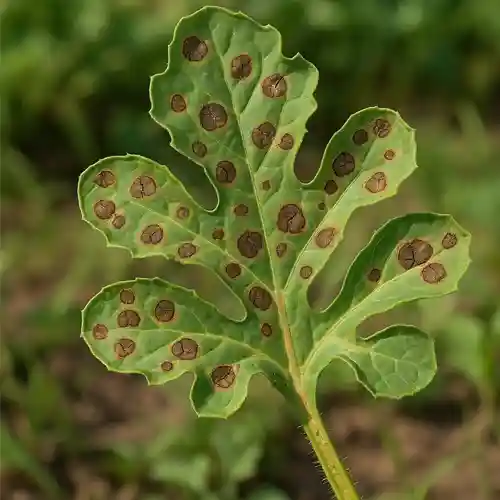
Dark brown, angular or circular spots on leaves that enlarge, crack, and cause twig dieback.
On stems and petioles, elongated light‑brown streaks appear.
Fruit lesions are round, 6–12 mm in diameter, sunken, and often cracked.
Biology:
The fungus survives on diseased debris and volunteer cucurbits; spores are spread by rain, irrigation, or runoff. Warm,
rainy conditions favor outbreaks.
Management:
Crop rotation, resistant hybrids, and preventive fungicide sprays every 7–14 days during flowering to
early fruit formation are effective.
Hybrid cultivars such as Himalaya F1, B32, Rhea, Radhion, and Camila show good tolerance.
USDA standards require certified hybrid watermelons to be free of Anthracnose infection.
Bacterial Fruit Blotch (Acidovorax citrulli)
Occasionally observed in Iran but with increasing frequency in recent years — most severe in transplant‑based fields .
Damage to leaves is minor, but fruit infection can reach 50% yield loss.
Symptoms:
Small, water‑soaked spots appear on leaves or cotyledons; later turn brown.
On fruits, water‑soaked lesions develop on the upper rind surface, expand rapidly, and lead to large necrotic soft areas that crack and
invite secondary fungal rot.
Biology:
The bacterium survives in seed — the primary source of epidemics.
High temperature and humidity, along with overhead irrigation and dense nursery conditions, increase disease incidence.
Management:
Use pathogen‑free seed and transplants, rotate crops, bury residues, and eliminate volunteer cucurbits.
Cercospora Leaf Spot (Cercospora citrullina)
A minor fungal disease but occasionally significant in humid regions of eastern and southern Iran.
Causes heavy defoliation and reduced fruit quality under prolonged moisture.
Symptoms:
Circular brown to purple spots (~6 mm) on leaves with grayish‑yellow centers and dark margins.
Spots coalesce, killing the leaves. Fruits are not directly affected.
Biology:
The fungus overwinters on crop debris and produces airborne spores.
Optimum temperature: 27–32 °C, extended leaf wetness enhances infection.
Management:
Three‑year rotation with non‑cucurbits, residue plowing, and protective fungicides are effective.
Downy Mildew (Pseudoperonospora cubensis)
A periodically severe disease in humid regions of Iran .
It causes rapid defoliation, yield loss, and fruit sun‑scald.
All cucurbits are susceptible, but melons and watermelons are most affected in Iran and the U.S.
Symptoms:
Angular yellow lesions on upper leaf surfaces; dense white‑gray downy growth on undersides.
Leaves turn brown and collapse under heavy infection.
Biology:
The pathogen produces airborne sporangia under high humidity and moderate temperatures; spreads quickly by wind and rain.
Management:
Use resistant cultivars, ensure crop rotation, maintain air circulation, apply protective fungicides, and monitor fields regularly.
Author
Engineer Bita Amini
Graduate of Agricultural Engineering, Shiraz University, Iran.